The Metal Doesn't Lie: How to Read a Bag's Hardware Before You Buy
Most bags are judged by the outside: the leather, the colour, the shape on the shelf. Fair enough. But the parts that decide whether a bag feels trustworthy six months later are usually the size of a fingernail. A zip slider that catches. A buckle that creaks. A D-ring attached with one line of stitching and a hopeful expression. Hardware is the tell. It is hard to fake, easy to test, and it says more about a maker's priorities than a label ever will.
Start with the zip, because you will use it most
Not all zips are equal, and the difference is not simply metal versus plastic. A nylon coil zip from a reputable maker will outlast a cheap metal zip with rough teeth. On a commuter bag, a size 8 or 10 nylon coil is often more practical than a chunky metal zip: lighter, more flexible around curves, and less likely to chew a coat sleeve. Metal zips look sharper and suit a more polished bag, but they need clean teeth and a slider that is properly aligned. Water-resistant zips have a coated tape or membrane; they feel stiffer, move more slowly, and should never be forced.
In the shop, run the slider the full length, including around any curve, with one finger under the tape. It should move with steady resistance, not graunch or snag. Check the teeth at the closed end: they should sit evenly, with no missing or bent teeth. Tug the pull sideways. If the slider separates, or the pull feels loose in its housing, put the bag down. A zip pull is a lever, and a small leather tab or cord makes it easier to use in gloves — a tiny detail that matters on a wet November morning.
Buckles: plastic is not a dirty word
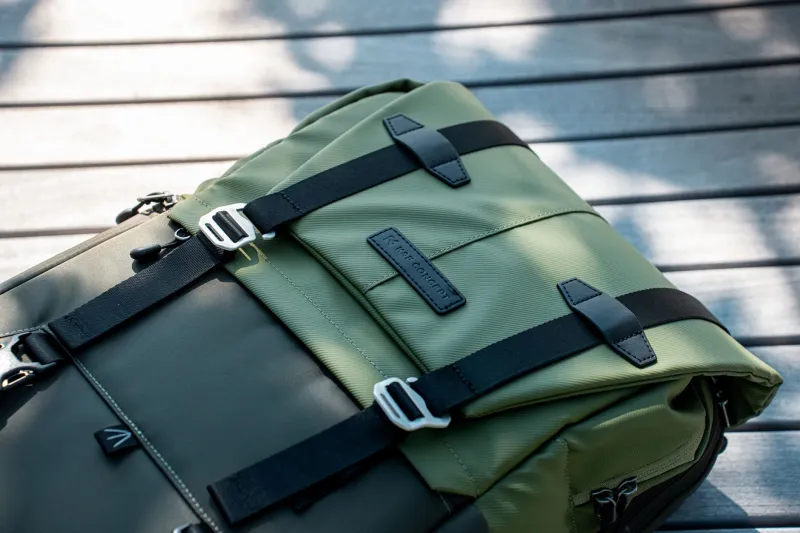
Acetal side-release buckles — often called Delrin — are excellent when they are made well. They are light, strong, and unaffected by rain. Cheap versions flex, squeak, and develop whitish stress marks at the prongs. A good buckle clips with a solid click and releases without a fight. Metal buckles look more premium, but they add weight and can be cold against the hand. Check the pin, the spring and the finish. A buckle that is load-bearing should feel slightly oversized for the strap.
Ladderlocks and strap keepers deserve the same attention. A loose keeper lets the strap tail flap about; a sharp-edged ladderlock can fray webbing. Clip and unclip the buckle five times in the shop. Squeeze the sides. If it bows or creaks, it is not up to a daily commute.
D-rings are only as strong as their mounting
A D-ring can be welded, brazed or seamed. A seamed ring has a join that can open under load; a welded ring is stronger but can still fail if the weld is poor. More important is how the ring is attached. Look for bar-tacked webbing, a rivet with a washer on the inside, or box-and-cross stitching through a reinforced tab. Pull the D-ring firmly and watch the fabric around it. If the ring is attached to a single layer of thin nylon, it is decorative, not load-bearing.
On a British commute, strap hardware rubs against a coat all day. Rounded edges and a smooth finish matter as much as strength. Rough cast metal can pill wool and snag knitwear.
Finish, wear and the British weather
Anodised aluminium wears to a dull sheen. Powder coating chips. Chrome flakes. Solid brass patinas. None of these is automatically bad; the question is whether the finish fails gracefully. Zinc alloy can pit in salt and rain, especially in winter. Stainless steel is heavier but honest. Road salt and grit are the real enemies, so rinse hardware with clean water and dry it properly rather than letting it sit damp in a hallway.
Coat abrasion is the quiet problem. A bag that swings at hip height will rub against a wool coat, a puffer or a waterproof shell. Check the hardware on the side that faces your body. If it has sharp corners or a rough casting, it will wear through fabric before the bag itself gives up.
The two-minute shop test
- Open and close every zip, including internal ones. Listen for crunching.
- Clip and unclip every buckle. Check for stress marks.
- Pull every D-ring and strap anchor. Watch the stitching, not just the metal.
- Turn the bag inside out, or as far as it will go. Look for washers, bar tacks and reinforced tabs.
- Put the bag on with your coat. Check where the hardware sits and whether it rubs.
- Look for spare buckles, replaceable straps or a repair policy. Good hardware is worth maintaining.
What to pay for
Hardware is not the whole bag, but it is one of the cheapest things a maker can skip. A bag with good hardware and average fabric will usually outlast a bag with beautiful leather and a rubbish zip. Price is not a guarantee — you are paying for the test, not the logo. The metal does not lie.