Storm Flaps, Zips and Seams: A Realistic Guide to Dry Kit
Every autumn the same message lands in our inbox: someone's commute bag has let water in and they can't work out why. Usually it's a bag with a decent reputation. Often there's a hydrostatic head figure somewhere in the spec, sometimes a fairly respectable one. And yet the notebook has gone wavy and the phone is sitting in a small puddle of its own making.
The answer, nine times out of ten, is that the number describes the fabric and nothing else. Rain doesn't sneak through the middle of a panel. It arrives at the joins, the openings and the parts that flex. So let's talk about the bits that actually decide whether your kit stays dry.
A hydrostatic head is a lab figure, not a forecast
That millimetre rating comes from a column of water pressed against a flat, new, uncreased piece of cloth in a test house. No seams. No abrasion. No strap tugging at a stitch line. No thirty-minute walk behind a bus with your bag on the wrong side.
It's a useful way of comparing one fabric to another. It is not a promise about the finished object you're carrying. A 5,000mm fabric with taped seams and a proper storm flap will outperform a 20,000mm fabric with a bare coil zip along the top and a seam running through the base corner. We'd rather buy the second-rate cloth and the first-rate construction, every time.
The zip is the honest weak point
Most leaks we hear about trace back to a zip. Not because zips are badly made, but because they are, by design, a row of gaps held shut by interlocking teeth.
- Standard coil zips are light and forgiving, but the tape either side of the teeth wicks water inwards. Fine under a flap; hopeless exposed on the top of a bag.
- Water-resistant zips — the ones with a polyurethane film bonded to the tape — are a genuine improvement in drizzle. They still aren't waterproof in sideways rain and they stiffen in the cold, which matters in February.
- Zip garages (a little pocket the pull tucks into at the end of the run) are cheap to add and quietly brilliant. If a bag has them, someone was paying attention.
- Storm flaps do more work than any zip upgrade. The flap must sit over the zip and hang downwards, ideally with a gutter fold so water runs off the edge rather than across the tape.
The classic failure isn't a fully closed bag at all. It's the zip left a centimetre open for a charging cable, or the top zip that sits in a dipped curve where water collects, or the side zip on a rucksack that faces the weather all the way up a hill.
Flaps, folds and roll-tops
Roll-tops are excellent when used properly, which means at least three folds, sides squeezed flat, and the whole thing clipped down tight. Rolled once and buckled loosely, a roll-top is just a bucket with a lid nearby.
Traditional flap-and-buckle closures work beautifully when the flap overhangs the body of the bag and the sides are gusseted. A flap that sits perfectly flush is mostly decoration. Magnetic closures are lovely for a pouch inside a bag and a poor choice for an outer pocket on a wet day. Drawstrings belong on laundry bags.
Seams, stitch holes and the bottom panel
Every stitch is a hole. On a good bag, the inside of the seams is taped or bound; on a great one, the seams are positioned so that water has to travel uphill to reach them. Look at the base — that's where water pools, and where the seam joining a reinforced panel to the body so often sits. A one-piece base, or a seam set high above the floor line, is worth paying for.
Strap and handle attachments matter too. Bar-tacked or box-and-cross stitching holds up; a couple of loose stitches will open up and start funnelling water along the webbing.
What British rain actually does
Three kinds of wet, and they behave differently.
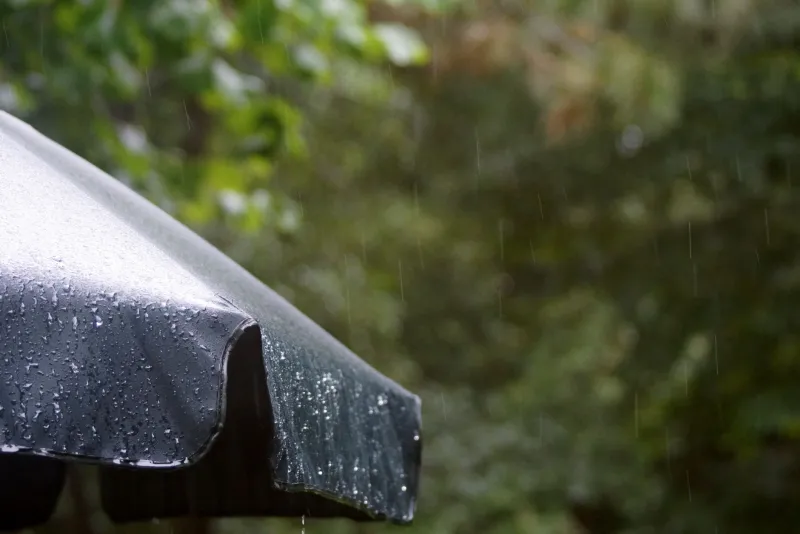
The long grey drizzle. An hour of it, low intensity, and the damage is done by capillary action rather than impact. Water creeps along zip tapes, up webbing straps and into any fabric that's lost its surface coating. This is the rain that finds a bag's weakest junction slowly.
Wind-driven rain. On a coastal path or a Mancunian side street, rain arrives horizontally and hits vertical surfaces square on. Flap direction, zip placement and pocket orientation all suddenly matter. A bag that shrugs off a shower can be soaked through by twenty minutes of this.
The puddle splash. A van through a kerbside puddle, a bus pulling out, the moment you set your bag down on a wet train floor. Splashes travel upwards, so a low side pocket or a base zip is at risk in a way it never is from above.
And a fourth, self-inflicted: the wet umbrella or waterproof jacket stuffed back inside the bag, quietly soaking everything it touches. A separate wet compartment or a simple dry bag solves that faster than any re-proofing.
The two-minute check before you buy
- Find the zip. Does it have a garage? Is there a flap behind or over it?
- Run a thumb along the inside of the zip line. Can you feel gaps?
- Look inside for taped or bound seams, especially at the base.
- Check where water would pool if the bag were left on a wet floor.
- Open and close the main closure one-handed, twenty times. Fiddly bags get left open.
- Push on the handle attachments. Do they creak or shift?
- Ask what happens to the fabric coating after a year of use — and whether it can be renewed.
Aftercare that earns its keep
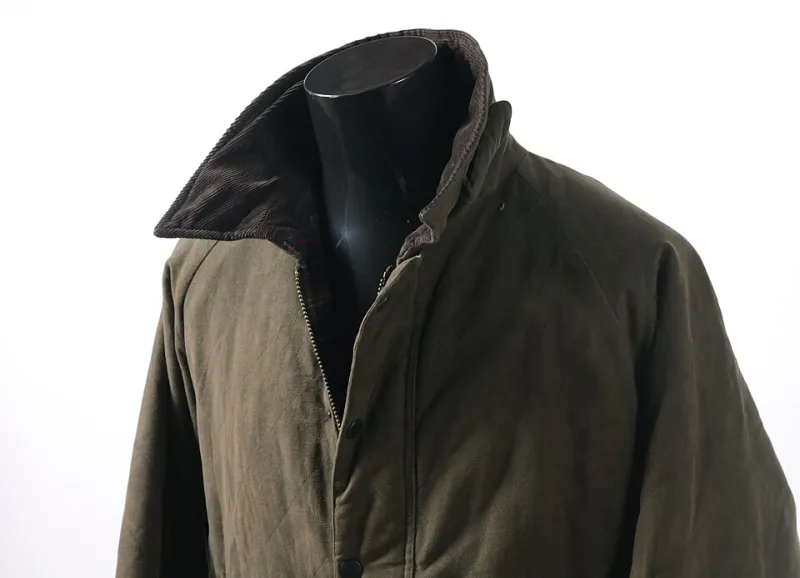
Surface coatings wear off; that's normal, not a fault. A spray-on re-proofer once a season (Grangers and Nikwax both make straightforward options) restores the beading. Wash with a technical cleaner, never detergent, and never machine-wash waxed cotton — re-wax it instead.
For zips: brush out grit with an old toothbrush, then apply a little silicone spray or dedicated zip wax. Sparingly. Grease attracts dust, dust grinds teeth, and a gritty zip is a leaking zip. Dry the bag fully before it goes back in the cupboard, and don't overstuff it — a strained zip is an open zip waiting to happen.
The short version
Buy the construction, not the number. A modest fabric with a covered zip, a taped seam and a base that doesn't pool water will keep your laptop drier than an expensive shell with a naked zip on top. Rain is patient, and it always goes for the join.