Tare Weight: The Number Your Bag Forgets to Mention

Photo: empty leather tote bag on kitchen weighing scales still life, via www.hello-hayley.com
There's a moment in every bag shop where you lift something off the rail by the handle, give it a little bounce, and decide. Feels solid. Feels about right. Then you get it home, load it with a laptop, a flask and the rest of your life, and spend Wednesday wondering why your shoulder is filing a formal complaint.
The thing you judged in the shop was the tare weight — what the bag weighs with absolutely nothing in it. It's the one specification almost nobody prints on the tag, and it quietly decides whether a bag earns its place by the door or ends up hanging behind it.
The bits you're actually carrying
A bag isn't a hollow shell. It's a small construction project, and every element has a gram count.
Lining. A plain woven polyester lining adds maybe 40–60g to a typical backpack. Double-lining, a padded laptop sleeve and a soft-touch inner pocket can push that past 150g. None of it is wasted — a decent lining protects your kit and stops your keys scratching the inside of a two-hundred-quid bag — but it isn't free either.
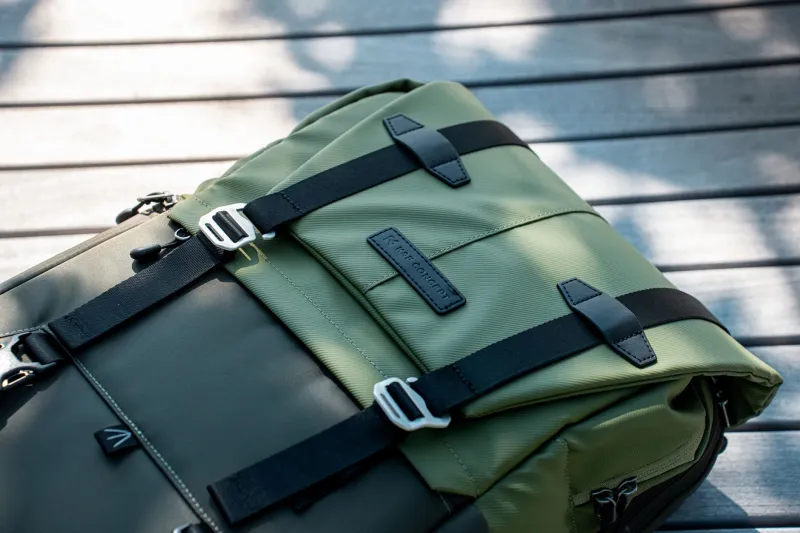
Hardware. This is where things get chunky. A solid brass buckle can weigh 50g on its own. Add two D-rings, a handful of rivets, a strap adjuster and a pair of chunky zips with leather pulls, and you've bolted on a small apple's worth of metal before you've put anything in. Cheap alloy hardware is lighter, and it's usually the reason a bag feels rattly after a year.
Base board. The stiffener that stops a tote collapsing into a sad puddle at your feet is normally high-density polyethylene or a compressed board, and it tends to run 80–200g. It's the difference between a bag that stands up on the floor of the 07:42 and one that folds itself around your ankles.
Strap and padding. A generously padded, wide shoulder strap with a sliding pad is a 100–150g commitment. It is also, gram for gram, the best value on the entire bag.
Pockets, feet and trim. Every zip, every slip pocket and every metal foot adds a few grams. Leather trim and rolled handles add a great deal more.
Doing the maths on a normal week
Suppose you commute five days a week and your bag weighs 400g empty. That isn't a big number. But it gets carried twice a day, out and back, so that's 4kg a week of pure bag — roughly 180kg across a working year. And if you're standing on a Northern line service for twenty minutes with it on one shoulder, that 400g is being levered against your neck by a strap about 4cm wide.
Here's the more useful way to think about it: as a percentage. A realistic daily load — 13-inch laptop, charger, bottle, lunchbox, umbrella, keys, wallet, phone, maybe a jumper — lands somewhere between 2.5kg and 3.5kg. A 400g bag is 12–15% of the total. A 900g bag is closer to a quarter. You feel that difference at six in the evening far more than you feel it at nine in the morning.
How to weigh one without looking strange
You can't walk kitchen scales into John Lewis, and the assistant will look at you oddly if you ask. So here's what actually works.
The hang test. Hook a finger through the handle and hold it at shoulder height for thirty seconds, ideally while doing something else — reading a label, checking your phone. If your arm is complaining before the timer's up, the bag is heavy empty, and it will be worse loaded.
The comparison test. Most rails hold a dozen options. Lift four in a row and rank them by feel rather than by price. Bags that feel noticeably heavier than their neighbours at a similar size are usually over-built in the lining and hardware.
The buy-two-weigh-one method. Plenty of UK retailers offer 28-day returns. Order two candidates, weigh both on kitchen scales the day they arrive, keep the one that wins on comfort and send the other back. Not glamorous, but honest.
The known-weight trick. A 500ml bottle of water is 500g. A paperback is about 250g. Hold the bag in one hand and the bottle in the other — your body is a decent scale once it has a reference point.
What to expect at each price point
Broadly, and with plenty of exceptions:
- Under £50: 600–900g is normal. Heavy coated fabrics, thick linings and bulky hardware are cheap to make and easy to hide.
- £50–£120: 400–700g. The middle of the market, and where the biggest variation lives.
- £120–£250: 350–600g. Better materials let a maker use less of them without the bag feeling flimsy — usually a good sign.
- £250 and up: anywhere from 300g (technical nylon, taped seams) to 1.4kg (a full-grain leather briefcase). Leather is heavy by nature. That isn't a fault, it's physics.
Why lighter isn't automatically kinder
This is the part the weight conversation usually misses. A 220g nylon tote with a 2cm webbing strap will cut into you the moment a laptop goes in. A 550g bag with a wide, contoured strap, a shaped back panel and a bit of structure will feel better at the end of the day, despite weighing twice as much.
Comfort is load, multiplied by time, divided by contact area. A heavier bag often spreads its weight properly. A very light bag frequently doesn't, and the load finds the thinnest part of the strap and settles there.
So weigh the empty bag — but then look at the strap, the back panel and the base. The grams only tell you half the story. The other half is about where they sit.
A short, slightly boring checklist
- Weigh your daily kit once, at home, so you know your baseline. Most people guess low.
- Strip the bag before you judge it: removable straps, rain covers and pouches all count.
- Choose the strap first, then the shell.
- If two bags are within 100g of each other, ignore the weight and pick the one that carries better.
- If a bag feels heavy empty, ask whether you'd still want it with 3kg inside. Usually you won't.
An empty bag is never really empty. It's a stack of decisions about lining, metal, board and padding, and you're carrying all of them. Worth knowing the number before you commit.