Coat First, Bag Second: Getting Crossbody Carry Right in the Cold

Photo by Photo by Bruno Martins on Unsplash on Unsplash
Every November, the same small betrayal happens. You put on a proper coat, reach for the crossbody bag that has behaved all autumn, and find that it now sits somewhere near your sternum. Nothing has shrunk. The bag has not changed. The layers have eaten the strap.
This is the layer allowance: the extra length a crossbody needs once a wool coat, padded parka or thick knit joins the outfit. Ignore it and you spend the cold months hitching the strap down, wrestling with a bag that swings too high, or giving up and carrying it by the handle. None of those are good looks, and none of them are comfortable on a damp bus.
The layer allowance, in plain numbers
A crossbody strap travels over one shoulder, across the body and down to the opposite hip. Anything bulky along that route effectively shortens the strap. A tailored wool overcoat might add a few centimetres to the path. A padded parka can add noticeably more. Add a chunky jumper underneath and the bag climbs again.
A useful starting point is around 5cm of extra strap length for a close-fitting wool coat, and closer to 8–10cm for a padded or oversized winter jacket. Those are not universal rules — body shape, coat cut and where you like the bag to sit all matter — but they are a better guide than assuming last month's setting will still work.
What you want is the top of the bag landing around the upper hip or just below the waist when the coat is on. If it is sitting at your ribs, the strap is too short for the outfit. If it is bouncing against your thigh, you have overcorrected and will probably hate it by the second bus stop.
Measure the bag you actually wear
Ignore the model in the product photo. She is not wearing your parka. The reliable test is simple: put on the coat you wear most in winter, fill the bag with your normal kit, and look in a full-length mirror.
Then use a tape measure or a piece of string to measure the usable strap length — the full path from one strap attachment point, over the shoulder, across the body and down to the other side. Note the number. If the bag has an adjuster, slide it to the longest sensible setting and measure again. That gives you two useful figures: what you have now, and what the bag can actually offer.
Do the same with a thick knit under the coat. You may find you need a different setting for a mild day than for a properly cold one. That is normal. A bag with a few centimetres of adjustment is far more useful than one fixed at a single fashionable length.
Where adjusters earn their keep
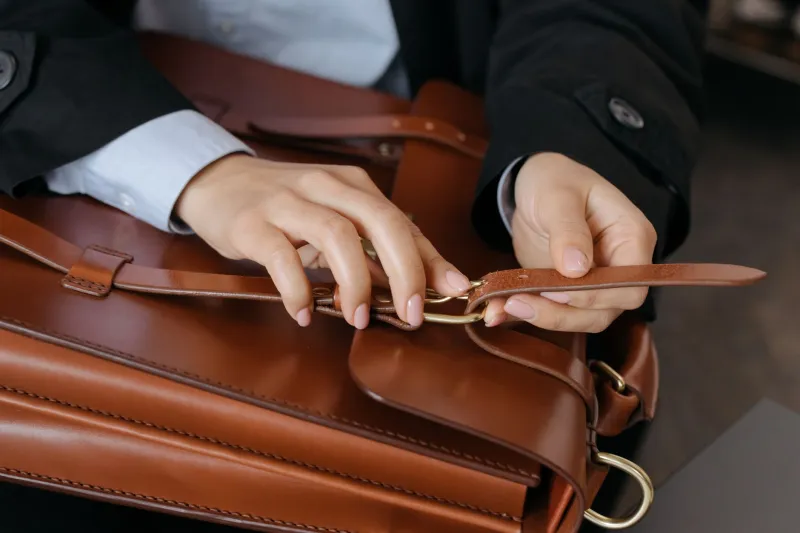
Not all adjusters are equal. A simple metal slider or two-bar buckle is easy to move and usually holds well. A cam buckle is quicker to adjust but can slip if the webbing is thin or glossy. If the adjuster sits under your arm when the bag is worn, it will annoy you every time you reach for it. Check that before you commit.
Also look at the tail. A long free end of strap flapping about is not a dealbreaker, but it is untidy. Some bags include a small loop or keeper to hold the excess. If not, a hair tie in a matching colour is a perfectly respectable fix, and nobody at the office will inspect it.
A removable strap opens up other options. You can swap in a longer webbing strap for parka days and keep the original for lighter coats. Just check the width and the clips match. A heavy bag on a skinny strap is a shoulder problem waiting to happen, especially over a padded coat.
Friction, fabric and the coat you love
Winter carrying is not only about length. It is also about what the strap does to your coat. Rough-edged canvas can catch on wool and leave a fuzzy patch where the strap has been rubbing. A smooth leather strap or fine webbing tends to glide more easily over a parka, though leather can feel stiff over a bulky shoulder.
If you wear a woollen overcoat most days, pay attention to the strap edge. A bound edge or a smooth finish is kinder than a raw one. If your winter coat is a shiny padded jacket, a wide webbing strap is usually the safer bet because it spreads the load and stays put. Chain straps look good in shop lighting, but over a thick coat they dig in and slide about. Leave them for evening bags and lighter layers.
The shop test that saves a return
When you try a crossbody in a shop this winter, wear the coat you will actually pair it with. If that is not possible, wear a thick jumper and ask to try the bag over a shop coat. Put it on, adjust the strap to its longest setting and walk a few steps. Reach for your phone. Open the main zip. Sit down. Check whether the bag lands on your hip or thumps against your ribs.
A bag that works over a parka may hang low indoors once the coat comes off. That is not a disaster if the strap adjusts quickly. Two or three inches of adjustment covers most indoor-to-outdoor shifts. But if the bag is already at its longest setting over a light jacket, it will never cope with a proper winter coat.
The coat gap is not really a gap in your wardrobe. It is a measurement you have not yet made. Get the strap length right for the layers you actually wear, and the bag will stop being something you fiddle with and go back to being something you simply carry.