The Shoulder Says No: Why Strap Width Is the Quiet Dealbreaker
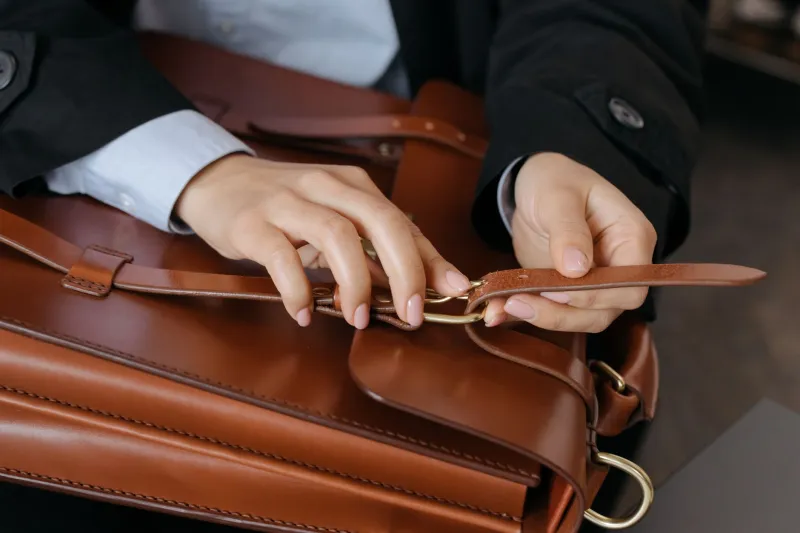
There is a particular kind of bag regret that has nothing to do with colour, price or whether it matches your coat. It happens about twenty minutes into a commute, when the bag is full and the strap has turned into a thin line of pressure across your shoulder. The bag looked right in the shop. It looked even better in the mirror. But the strap was never asked to do the actual work.
Strap width is one of those details that quietly decides whether a bag becomes part of your routine or stays in the wardrobe. It is not glamorous, and it rarely appears in the product description beyond a passing measurement. Yet it governs how a loaded bag behaves on a real shoulder, on a real bus, in real British weather.
The physics are boring, which is why they matter
A loaded bag does not spread its weight evenly across your body. It concentrates it wherever the strap touches. A narrow strap puts that force into a small area, so the shoulder feels every kilo. A wider strap spreads the same load over more surface, which usually feels calmer and less pointy. This is not a luxury feature. It is basic load-bearing common sense.
That does not mean every strap should be as wide as a seatbelt. A slim strap can be perfectly fine on a light crossbody holding a phone, cardholder and keys. The trouble starts when a bag is designed to carry a laptop, a water bottle, a folded umbrella and the rest of a normal day, but the strap is styled like it belongs to a tiny evening bag. The bag has been given a job it cannot physically do well.
Padding complicates things further. A padded strap can feel lovely in the shop, but padding compresses over time. If the padding is thin and the strap underneath is narrow, the comfort disappears once the bag is loaded. Look for padding that has some structure rather than just softness, and check whether it runs along the part of the strap that actually sits on your shoulder rather than stopping awkwardly near the attachment point.
Attachment points tell their own story
The width of the strap is only half the tale. Where it joins the bag matters just as much. A strap attached to a single narrow tab or a small ring will pull the bag into a lopsided shape when loaded. Better bags spread the connection across a wider panel or use two points to keep the bag hanging evenly. If the attachment looks like an afterthought, it probably is.
Hardware is part of this too. A thin metal ring can be strong, but it can also create a hard pressure point if it sits exactly where the strap meets the shoulder. Give the join a squeeze in the shop. If you can feel a sharp edge through the strap, you will feel it even more with a laptop inside.
Test it like a commuter, not a shopper
The biggest mistake is testing a bag empty. An empty bag tells you almost nothing. Before you go shopping, make a small pile of the things you genuinely carry: laptop or tablet, charger, water bottle, umbrella, lunch, notebook, whatever the day actually involves. If you are not carrying those things to the shop, approximate them. A couple of hardback books and a full water bottle will do a surprisingly good impression of a working day.
Put them in the bag. Put the bag on. Then walk. Not a slow lap of the shop floor, but a proper walk: up and down the aisle, up a flight of stairs if there is one, and reach above your head as if you are grabbing a handrail or a coat from a hook. A good strap should stay put without you constantly hitching it back into place. It should not dig in, twist or force you to hold your shoulder at an odd angle.
If the bag has a crossbody strap, check how it sits across your chest and back. A wide strap can be brilliant here because it spreads the load, but it needs to lie flat rather than roll into a tube. If the strap curls, the edge will do the digging. Adjust the length and try again. A bag that only works at one exact length is a bag that will annoy you by February.
The two-inch rule is not really a rule
There is a useful shorthand that a strap around two inches wide is a sensible starting point for a bag that will carry a decent daily load. But it is a starting point, not a law. A well-shaped 1.5-inch strap with proper padding and good attachment points can outperform a badly designed two-inch strap. Equally, a wide strap made from stiff material can feel like a piece of luggage strapped to your shoulder.
What matters is the combination: width, padding, flexibility and how the bag hangs. A strap should feel like it is sharing the weight with you, not making a point of it. If you have a shoulder that already complains after a long day, this is the detail to prioritise over almost everything else.
A quick shop-floor checklist
Load the bag with realistic weight. Put it on the shoulder you actually use. Walk for longer than feels polite. Check the strap edge with your fingers. Look at the attachment points while the bag is hanging. Try it over a coat, because a British commute often involves a raincoat or a bulky jumper. Then try it without the coat, because the same bag has to work in July too.
Finally, ask yourself whether you would be happy carrying it for twenty minutes, not two. That is the test that matters. A bag can be elegant, useful and well made, but if the strap cannot handle the contents, it will not come home with you for long. Better to find that out in the shop than halfway to the station.