Reach, Not Rummage: How Pocket Placement Makes or Breaks a Daily Bag
Photo: Bryson Jack, Ministry of Information Photo Division Photographer, Public domain, via Wikimedia Commons
There is a particular kind of defeat that happens at a ticket barrier. You have your phone in one hand, a coffee in the other, and a bag on your shoulder that apparently contains a small, hostile jumble sale. The travel card is in there somewhere. So is the work pass. Possibly also a hair clip and half a flapjack. You step aside, unzip three compartments, and let the queue behind you learn a little about your organisational habits.
A bag with more pockets would not necessarily fix this. In fact, a bag with more pockets can make it worse. What matters is not capacity but placement: whether the things you need most often are where your hand naturally goes, whether the things you need to protect are tucked away properly, and whether the bulkier items have somewhere sensible to live without colonising everything else.
Start with the pocket map, not the pocket count
A useful way to judge a bag is to sketch a small map of your daily carry. Not a list of everything you own, but the five or six things that leave the house with you almost every day. For most commuters, that looks something like this: phone, keys, wallet or cardholder, travel card or phone-based ticket, work pass, and a folded umbrella. A lip balm, a charger cable and a pair of headphones usually join the party too.
Once you have that list, you can ask a more useful question than 'how many pockets does this have?' You can ask: where would each of these actually live?
The answer should be obvious before you buy. If you have to invent a system in the shop, the bag is probably asking too much of you at 7:40am.
The front line: what your hand reaches for on the move
Some items need to be accessible while you are walking, standing, or holding onto a rail on the Northern line. Your phone and your travel card are the obvious pair. They should sit in a pocket you can reach with one hand, ideally without taking the bag off your shoulder or swinging it round like a shopping trolley.
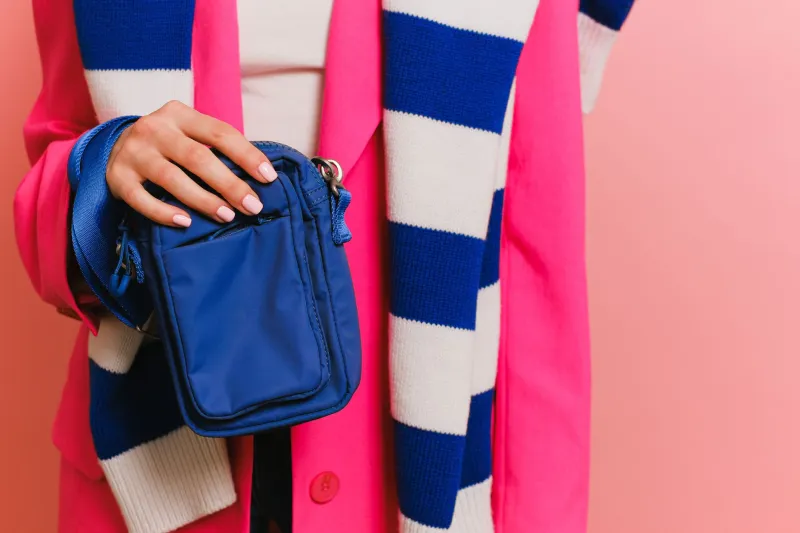
On a shoulder bag, that usually means an outer pocket or a top-access zip. On a backpack, it means a side or top pocket, not a deep internal sleeve that requires you to take the whole thing off and unclip it. On a tote, it means a slip pocket that holds a phone upright rather than letting it slide into the corner with your keys.
The test is simple: can you get your phone out and put it back while wearing gloves, without looking down for more than a second? If not, the pocket is decorative rather than useful.
The reserve: what needs security more than speed
Keys are the awkward one. They are small, jangly, and expensive to replace. They do not need to be instantly reachable in the same way as a travel card, but they do need to be findable and secure. A shallow outer pocket with no closure is not a key pocket. It is a donation point.
Wallet, cardholder and work pass belong in the same general zone: close to the body, behind a zip, and not in a pocket that opens outwards when the bag is turned. On a crowded train or in a busy pub, a pocket that faces the world is a pocket that invites trouble. A zip that runs against your body is a quiet, sensible friend.
The same goes for anything you would rather not lose: a small pouch of medication, a spare bank card, a USB stick with the presentation you spent all week on. They do not need to be in the front line. They need to be in the reserve, where you know where they are and nobody else does.
The overflow: giving bulk its own space
A folded umbrella is the classic test of pocket placement because it is long, damp and awkward. It does not want to share a pocket with your phone. It does not want to be crushed into a tiny zip pouch. It wants a sleeve, a side pocket, or a dedicated slot that lets it sit vertically without deforming the rest of the bag.
If your bag has no sensible umbrella home, you will end up carrying it separately, which defeats the point of carrying a bag at all. The same principle applies to a water bottle, a paperback, or a pair of flat shoes. Bulk needs a lane of its own. When it does not get one, it drifts into the phone pocket and starts a small turf war.
The shop test: empty your bag and try again
When you are looking at a bag in a shop, do not just unzip it and nod at the number of compartments. Take your own things out of your current bag and put them into the candidate. This is slightly awkward. Do it anyway.
Put your phone in the pocket you would naturally use. Then try to get it out with one hand. Put your keys where you think they would go, then see whether they rattle against your phone or disappear into a lining gap. Put your travel card where you would reach for it at the barrier. Then imagine doing that with a coat on, a queue behind you, and a train already in the platform.
A good bag passes this test quickly. A bad one makes you realise you have been negotiating with it since the moment you picked it up.
Why crowded pockets lose
A bag with many pockets often sounds efficient. In practice, more compartments mean more places for things to hide. You put your card in the 'right' pocket on Monday, forget which one on Tuesday, and by Friday you are performing the same pat-down in a coffee shop queue. Too many pockets also encourage over-packing: each one becomes a small excuse to carry something you do not really need.
The best everyday bags tend to have a small number of well-placed pockets, each with a clear job. One for the phone, one for keys and cards, one for a travel card, one for bulk. That is usually enough. The bag does not need to be a filing cabinet. It needs to be predictable.
The quiet rule
If you remember nothing else, remember this: a pocket earns its place by being in the right spot, not by existing. Reach, security and bulk are the three things to watch. The rest is just zips.