The Other Hand: Choosing a Bag When Every Zip Pulls the Wrong Way
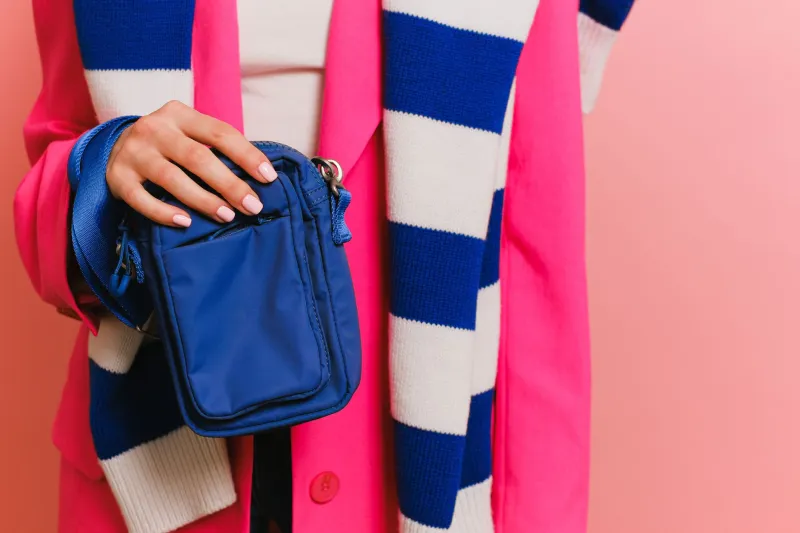
Most bags are designed by right-handed people for right-handed people, and most of the time that is fine. You sling it on, you reach for the zip, you get on with your day. But if your left hand is the one that always gets there first, the friction shows up in small, repeated ways: a zip pull that sits on the far side of the opening, a front pocket that forces a twist at the shoulder, a padded strap that only ever feels right on one shoulder. On a packed commuter train, that twist matters more than it does in the shop mirror.
This is not a campaign for special left-handed bags. It is a guide to noticing the handful of design decisions that decide whether a bag works with your body or against it — and knowing which ones are worth adapting.
Start with your reach, not the label
Stand up. Pretend you are wearing a cross-body bag. Which shoulder does it naturally land on? Which hand drops to the bag first when you need a phone, a card, a tissue?
For a lot of left-handed people, the bag sits on the right shoulder and crosses to the left hip, so the left hand has clear access to the front of the bag. For others, the opposite feels natural. There is no correct answer, but there is a correct answer for you, and it is worth knowing before you start shopping.
A simple test: put your everyday coat on, then mime reaching for your phone. The side your hand goes to is the side your bag's quick-access pocket should be on. If it is not, you will spend the life of the bag reaching across your body or swinging the bag round to the front.
The zip pull is the tell
Hardware placement is where right-handed defaults show up most clearly. On many shoulder bags, the main zip opens from right to left, with the pull resting on the right-hand side when closed. That suits a right hand. A left hand has to cross the opening, or use an awkward pinch grip, every time.
Look for:
- Two-way zips, which let you open from either end.
- Zip pulls that can be swapped to the other side of the slider, or replaced with a longer cord pull.
- Symmetrical top openings, where the zip runs across the middle and either hand can work it.
- Magnetic or press-stud closures placed centrally, rather than a single buckle set off to one side.
Clasps and buckles matter too. A single central clasp is neutral. A clasp that sits to the right of centre, with a strap that feeds through it, is not. If you have to rotate the bag to undo it, that is a daily tax.
Pockets are not neutral ground
A pocket on the front of a bag looks symmetrical in photographs. In use, it has a side. The opening faces one way, the lining sits one way, and the hand that reaches in has a natural line of approach.
Before you buy, load the bag with your actual kit — phone, keys, cardholder, headphones, whatever else lives in there. Then try to get each item out without looking. If you have to unzip, rummage and re-zip with your non-dominant hand, the pocket layout is wrong for you. If your dominant hand finds the phone in one movement, it is right.
Also check the back pocket, the one that sits against your body. On a commuter bag it is often the most-used pocket of all, and it is usually cut for a right hand to slide into from the right side. On a crowded Tube carriage, that is the difference between a quiet reach and a full-body shuffle.
The strap has a favourite shoulder
Cross-body straps are not symmetrical. The padded section sits over one shoulder, the adjuster buckle sits somewhere along the length, and the strap keeper — the little loop that holds the tail — is on one side. Reverse the bag and the padding may press into your neck, or the buckle may dig into your collarbone.
Try the bag on both shoulders, even if you think you know which one you prefer. Wear it over a coat, because a winter jacket changes the fit. Sit down in it, because the strap will ride up. And check the tail: a long strap end that hangs on the wrong side will flap against your arm as you walk.
If the strap is detachable and can be rethreaded, a right-handed bag can often become left-hand friendly in about two minutes. If the padded section is fixed and shaped, it probably cannot.
When to adapt, and when to walk away
Adaptation is worth it when the fix is small and reversible. Swapping a zip pull, rethreading a strap, adding a longer cord to a slider, or moving a key leash from one side to the other are all jobs a decent repair bench can do for a modest sum. Ask before you buy: can this be changed without cutting, and will it still look right afterwards?
Walk away when the asymmetry is structural. A messenger bag with a single right-side buckle, a flap cut to open one way, a padded strap sewn into a fixed curve — these are not impossible to alter, but the cost and the risk of ruining the shape usually outweigh the benefit. There are enough well-made bags with neutral hardware that you do not need to fight a bad one.
A five-minute shop test
- Wear the coat you will actually commute in.
- Put the bag on the shoulder you naturally use, then the other one.
- Load your phone and keys into the pockets you would use most.
- Close your eyes and reach for the phone. Time yourself. If it takes more than a couple of seconds, note why.
- Open and close the main compartment three times, using only your dominant hand.
- Check the mirror: does the bag sit level, or does it pull to one side?
None of this requires a special left-handed range. It requires a shop assistant who will let you spend five minutes actually using the bag, and a willingness to put it back on the shelf if the answer is no.
The right bag for a left-handed carry is not a niche product. It is a bag whose hardware, pockets and strap do not assume a hand you do not have. Get those three things right, and the rest — colour, material, brand — is just preference.