The Free-Hand Rule: What Actually Belongs in a Christmas Market Bag

Photo: Sandy B , CC BY-SA 2.0, via Wikimedia Commons
By mid-November, the UK Christmas market season is already in full swing. The wooden huts are up, the bratwurst queue is forming, and the daylight has clocked off before the office has. It is a lovely way to spend an afternoon. It is also a proper test of whatever you have slung over your shoulder.
A Christmas market is not a shopping centre with better lighting. It is a crowd, a maze of temporary stalls, a series of small transactions, and a slow shuffle towards public transport in the dark. Your bag has to cope with all of that while staying out of the way. That is the brief. Not 'carry everything'. Not 'look festive'. Just: keep your hands free, your valuables close, and your patience intact.
Start with the day, not the bag
The first mistake is packing for a fictional full-day expedition. Most Christmas market trips are three to five hours: a wander, a couple of drinks, something fried, a look at the lights, then home. That does not require a tote the size of a weekend bag.
The realistic contents are modest. Phone. Card or a small amount of cash. Keys. Lip balm. A compact foldaway tote for any purchases. If the forecast is properly grim, a small umbrella. That is about it. A bulky water bottle, a paperback, a laptop and a 'just in case' jumper can stay at home. You will be standing, squeezing past people and balancing a paper cup. Weight matters more than you think after the second hour.
Cross-body, close to the body
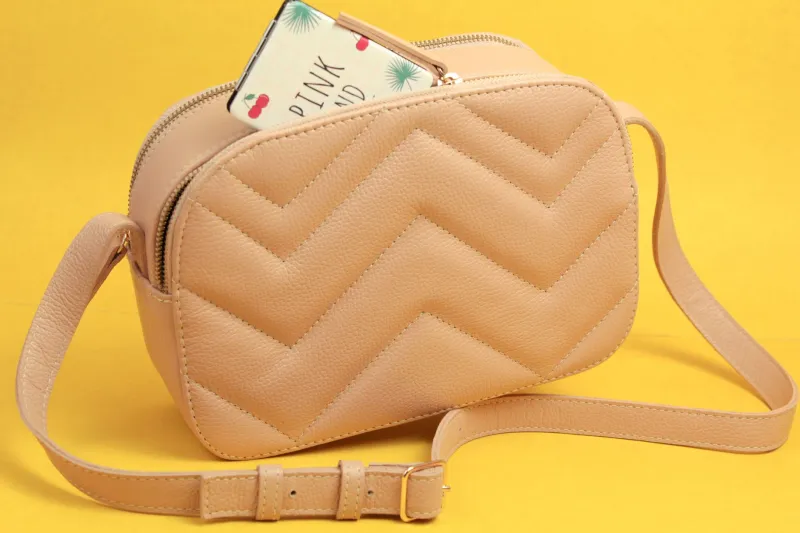
Security in a crowd is mostly about placement. A bag that hangs behind you, swings off one shoulder or sits open at the top is an invitation. A cross-body bag worn with the body of the bag at the front or tucked under your arm is far easier to keep an eye on. It also frees both hands, which is the whole point when you are holding a drink, a phone and a paper cone of something with too much sugar on it.
Backpacks are not the villain here, but they are awkward in tight stalls. You become wider than you think, and every turn risks clouting someone. A shoulder bag that keeps sliding down is worse. Look for a cross-body strap you can adjust without taking the bag off, and check that the strap does not leave a long loop dangling behind you. In a busy market, tidy straps are a quiet form of good manners.
Materials that forgive mulled wine
Mulled wine is not a delicate beverage. It is hot, sticky, red and frequently served in a cup with a lid that is only theoretically secure. If you are carrying a bag at hip height in a crowd, assume a splash is possible.
This is not the day for pale suede, untreated canvas or a light-coloured leather that marks at the first drop. Recycled nylon is the easy answer: wipe it with a damp cloth and move on. Waxed cotton copes well with drizzle and general grime, though a sugary spill should be blotted rather than scrubbed. Dark full-grain leather is forgiving too, provided you are not the sort to panic over a patina. A dark lining is a small mercy. So is a bag with few seams on the outside, where sticky things like to collect.
The glove problem
Cold hands make small fastenings a nuisance. Tiny zip pulls, fiddly magnetic clasps and narrow openings are all fine in a warm shop. At an outdoor stall in the dark, with gloves on, they become a test of temper.
Look for zip pulls you can hook a finger through. A main compartment that opens wide enough to see inside. A phone pocket that does not require you to unpack the whole bag. You do not need a dozen compartments; you need two or three that make sense. One for valuables, one for the things you reach for constantly, and one main space for everything else. Anything more becomes a rummage, and rummaging in a crowd is how gloves, cards and patience get lost.
The bag inside the bag
A small pouch is the unsung hero of market season. Keep your card, cash, keys and lip balm in one zip-top pouch that can move from your bag to a coat pocket if you stop for a sit-down. It also means you are not opening your main bag every time you buy a drink.
Then add a foldaway tote. Christmas markets are full of things you did not plan to buy: a jar of something, a wrapped cheese, a small ceramic object that seemed essential after a mulled wine. A flat-packed tote takes up almost no room and saves you from trying to wedge a fragile purchase into an already full cross-body. It also gives you a plan B for the journey home.
The tube home test
The real audit happens on public transport. Can the bag sit on your lap without spilling? Does the strap catch on turnstiles or other people? Can you hold it closed while standing? A soft, overstuffed tote fails this test. A cross-body bag with a secure zip passes.
If you have bought something bulky, put it in the foldaway tote and keep your everyday bag light. If you are on the Tube, keep the main zip closed even when the carriage is quiet. It is not about paranoia; it is about not having to think about it. The best Christmas market bag is the one you forget you are wearing until you need it.
A short checklist
- Cross-body strap, adjustable, no long dangling ends.
- A main zip that closes properly and a phone pocket you can reach without unpacking.
- Wipe-clean or dark, forgiving material. Nothing pale and porous.
- Zip pulls that work with gloves on.
- Small pouch for valuables; foldaway tote for purchases.
- Nothing in the bag that belongs at home.
Christmas markets are meant to be a bit chaotic. The bag should not add to it. Pick something practical, keep it close, and leave enough room for the one thing you will inevitably buy. Then get the Tube home with both hands free and your mulled wine where it belongs — in the cup, not on your sleeve.